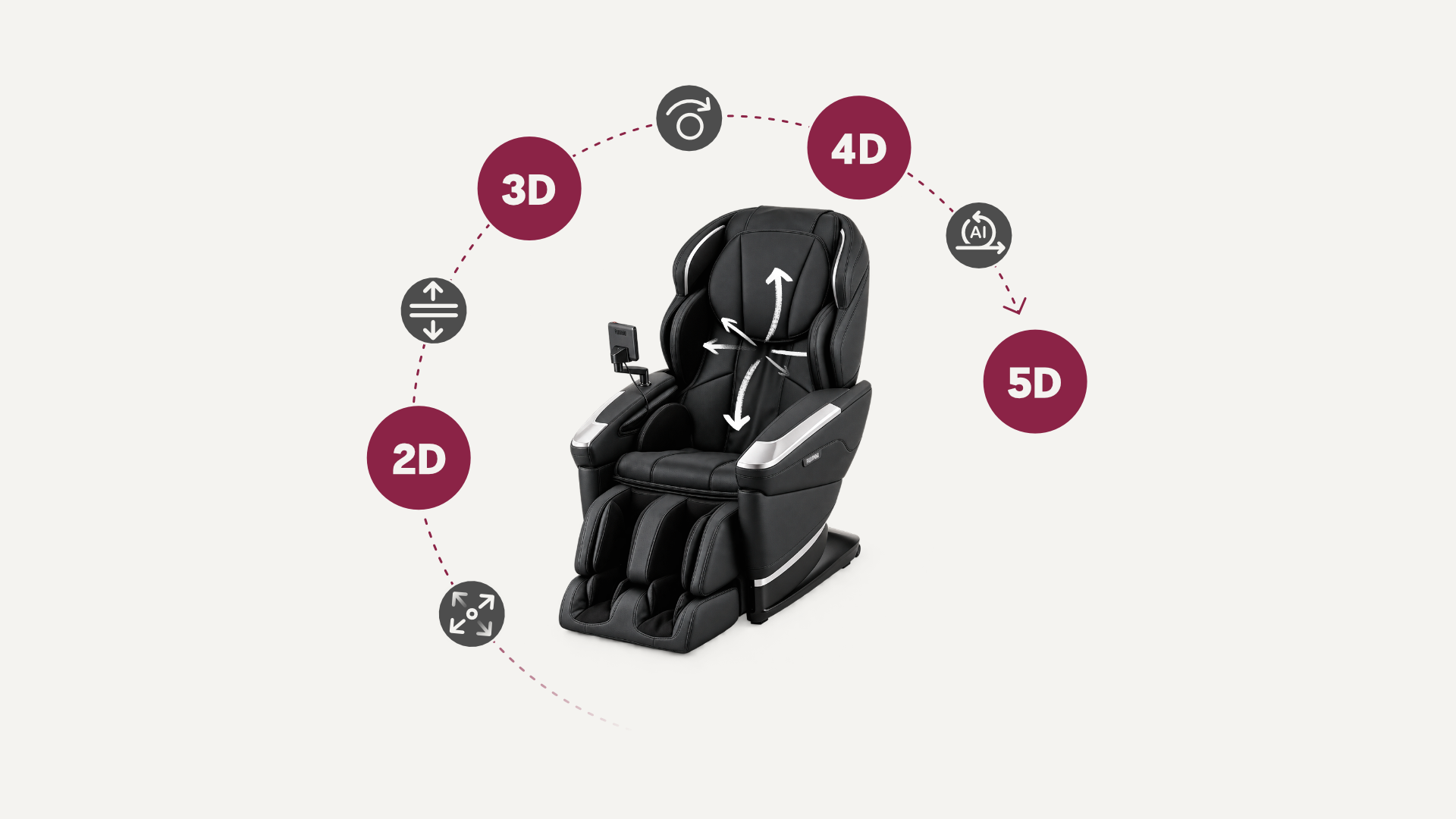
2D, 3D, 4D, 5D AI+, XD, XD PRO, XD FLEX… When comparing massage chairs, you will quickly come across terms that, without further explanation, reveal little about how the massage mechanism actually works. What do the different massage “dimensions” mean, how do the individual systems differ, and how do they affect the way the massage arms operate? Here is what you need to know.
It is worth clarifying from the outset that terms such as 2D, 3D and 4D do not refer to the number of planes in which the massage arms physically move. They primarily describe the range and method of adjustment of the massage mechanism, while more advanced systems may also incorporate additional parameters that affect the massage course. Manufacturers also develop proprietary technologies and use their own names to describe them. So let’s take a closer look at what the different massage system designations in massage chairs actually mean.
2D massage in a massage chair
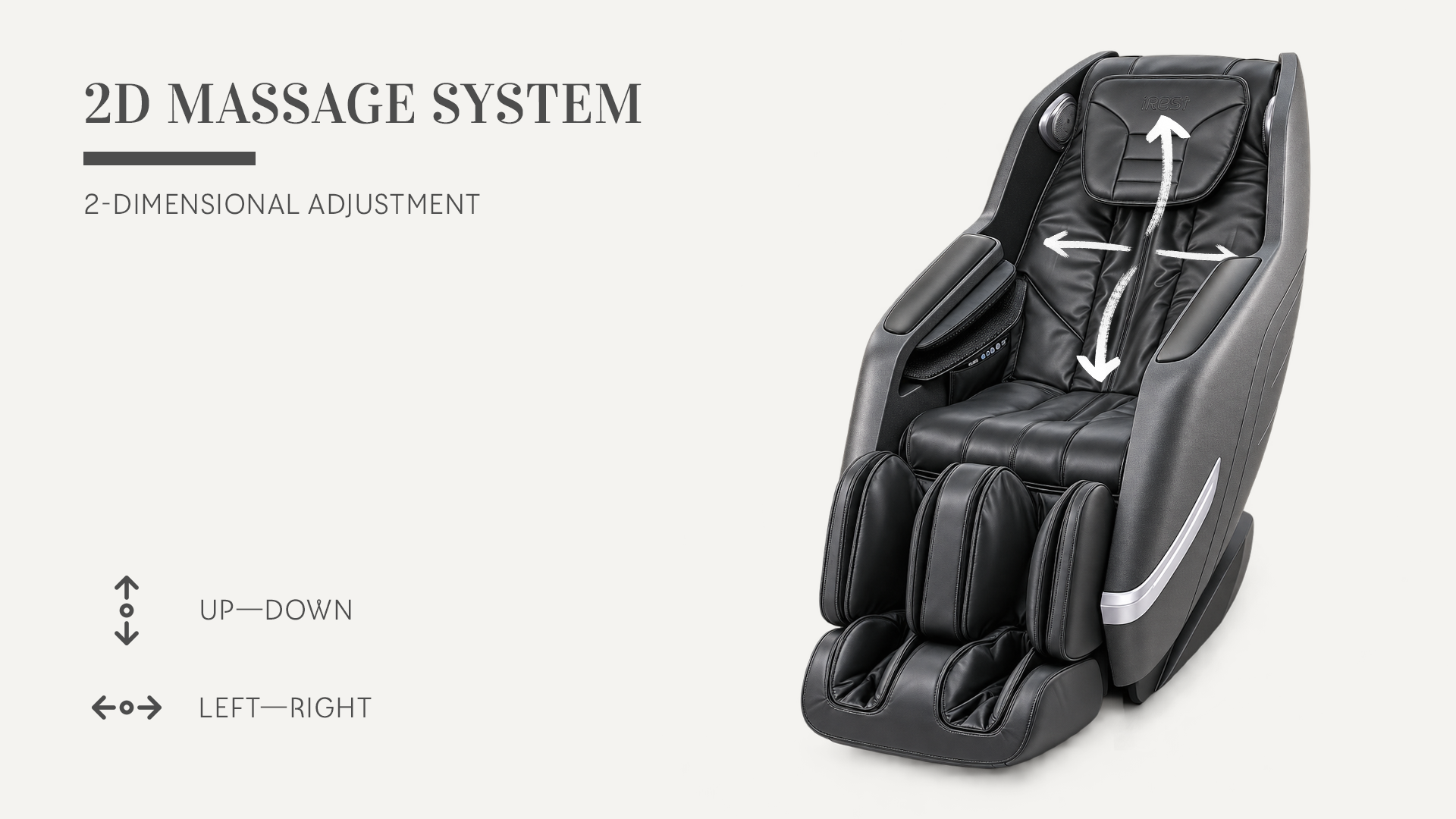
Basic massage chair models use a 2D system. This means that the operation of the massage arms can be adjusted in two dimensions: up and down, and from side to side.
However, this does not mean that the massage arms move exclusively in two planes. Despite the lack of a mechanically adjustable third dimension, their construction allows them to perform three-dimensional movements while maintaining contact with the back.
3D massage in a massage chair – how does it work?
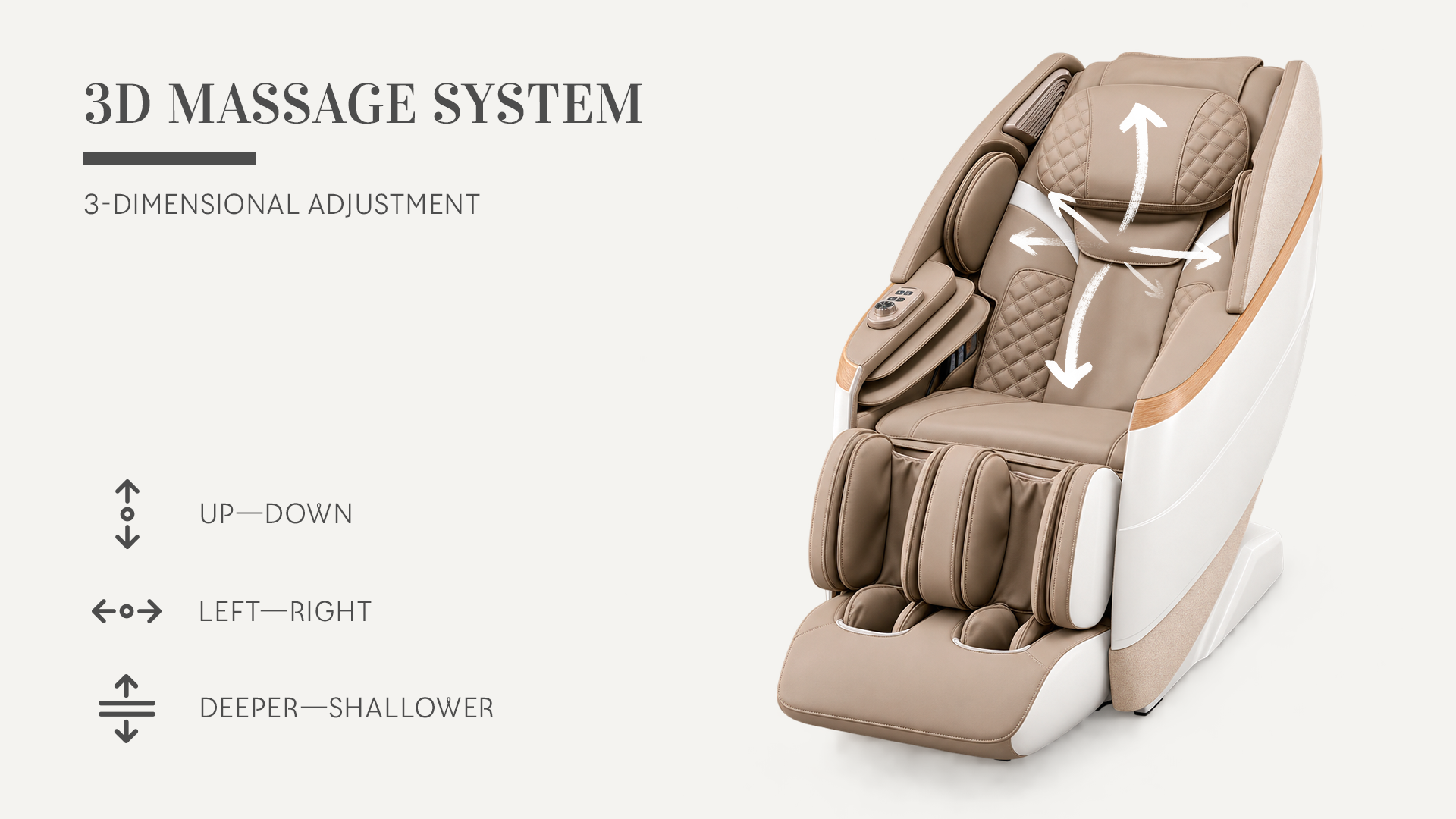
A more advanced technology is the 3D system. In this case, the operation of the massage arms can be adjusted in three dimensions: up and down, from side to side, and deeper or shallower. The key difference compared with a 2D system is therefore the ability to mechanically adjust how far the massage arms extend forwards and backwards. This makes it possible to adjust the depth of their movement and, consequently, the massage intensity.
The third dimension does not mean that the massage arms only begin to perform three-dimensional movements in a 3D system. The difference lies in the additional adjustment of the massage mechanism, which a conventional 2D system does not offer.
The adjustment characteristic of 3D systems is also used in Bodyfriend’s proprietary XD and XD FLEX systems, which are the manufacturer’s own technological solutions.
4D massage in a massage chair – how does it differ from 3D?
A 4D system retains the three dimensions of adjustment found in 3D technology, while adding variable massage arm speed as an additional parameter. Bodyfriend’s proprietary technology using the adjustment characteristic of a 4D system is XD PRO.
The mechanism does not have to perform an entire movement at a uniform speed. The massage arms can begin a movement more slowly, then accelerate and subsequently slow down again. This acceleration, meaning programmed changes in the speed of the massage arms during a movement, is a characteristic element of the fourth massage dimension.
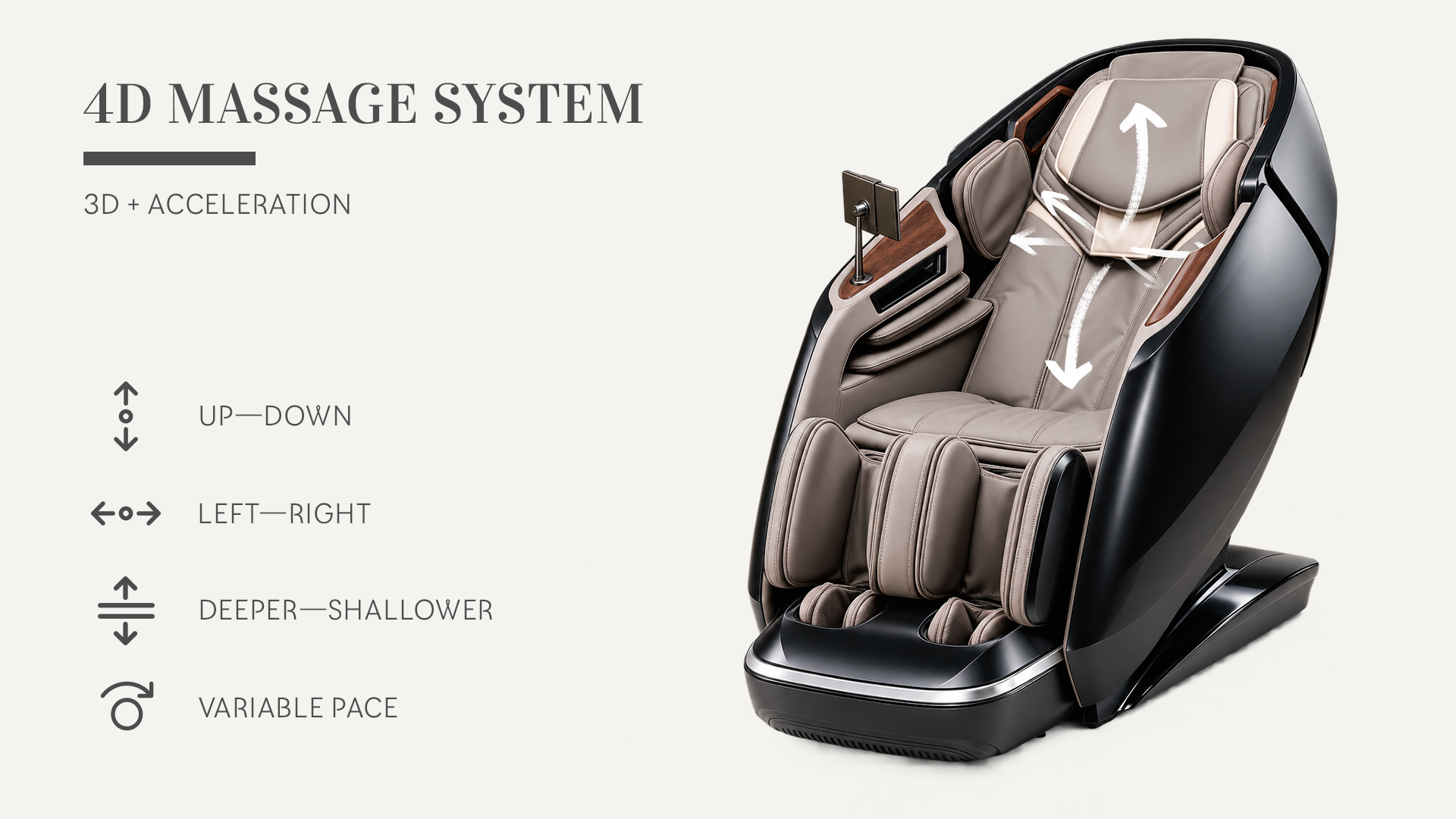
Does this mean that 4D will always be a better choice than 3D? Not necessarily. A 4D system offers more extensive adjustment of the massage mechanism, but the overall massage experience is also influenced by the mechanism’s construction, massage range, available massage techniques and additional functions. The massage system should therefore be considered one of the parameters of a massage chair rather than the sole criterion for assessing its capabilities.
5D AI+ massage in Fujiiryoki massage chairs
The 5D AI+ system found in Japanese Fujiiryoki massage chairs should be understood somewhat differently. It does not introduce another physical plane of massage arm movement. Instead, it expands the capabilities of a 4D system through the use of artificial intelligence.
The 5D AI+ system uses an artificial intelligence algorithm that identifies muscle condition and, based on the information collected, adjusts massage intensity in real time. Artificial intelligence can also influence other parameters of the massage, including its speed and the techniques used.
In the 5D AI+ system, the additional dimension therefore refers to using information analysed in real time to control the course of the massage. This allows the operating parameters of the mechanism to change during the session.
Proprietary massage systems in massage chairs
Popular designations such as 2D, 3D and 4D are not the only ways of describing the technologies used in massage chairs. Manufacturers also develop their own proprietary technologies with individual designations, including the previously mentioned XD, XD FLEX, XD PRO and 5D AI+.
Another proprietary technology is V-Hand™ Plus by Singaporean brand OSIM. This patented system uses massage balls with a 720° range of motion, allowing the massage arms to perform complex three-dimensional movements.
This demonstrates why designations such as 2D, 3D and 4D should not be treated as a complete representation of a massage chair’s capabilities. When comparing individual models, it is therefore worth looking beyond the name of the system and considering the range and method of massage arm adjustment, the construction of the mechanism and its capabilities.
Massage systems in Rest Lords massage chairs
The differences between individual technologies are easiest to understand by looking at specific models. Our range includes massage chairs equipped with different massage systems, dual massage mechanisms and proprietary manufacturer technologies. The table below shows the systems used in massage chairs currently available from Rest Lords.
| Massage chair | Massage system |
| iRest QL (A185) | 2D |
| iRest Easyq (A166) | 2D |
| iRest Chillin+ (A360) | 2D |
| iRest Chillin Open (A360-31) | 2D |
| iRest R-Pass (T103) | 2D |
| iRest Supearl+ (A336) | Smart 2D* |
| iRest Supearl Open+ (A336-31) | Smart 2D* |
| iRest Queentri (A357) | Smart 3D* |
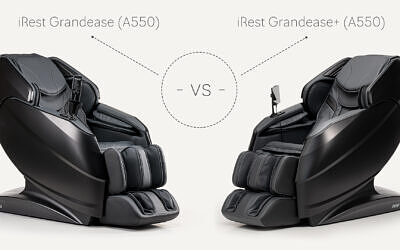
| iRest Grandease+ (A550) | 4D |
| iRest Brillactiq (A665) | 4D |
| iRest Eagleton | Double massage mechanism: XD FLEX + 3D |
| iRest Maesthron (A801) | Double massage mechanism: 4D + 2D |
| iRest Dual Core V8 | Double massage mechanism: 4D + 2D |
| Fujiiryoki JP4000 | 5D AI+ |
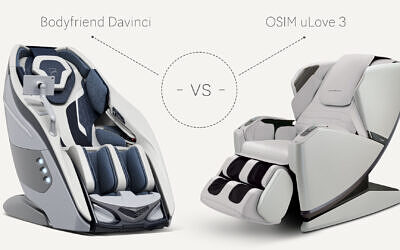
| Bodyfriend Davinci | XD PRO |
| Bodyfriend Quantum Beauty Capsule | XD PRO |
| OSIM uLove 3 | Double massage mechanism: V-Hand™ Plus + 3D |
The massage system is one of the key elements influencing how a massage chair operates, but it should not be the only criterion when choosing a model. Individual chairs differ in the construction of their mechanisms, massage range, massage techniques, automatic programmes and additional functions. As a result, even two chairs using the same type of massage system can provide a different massage experience.
Specifications help you understand how the massage mechanism can be adjusted, but only trying a chair for yourself allows you to experience the differences between individual technologies. In our showrooms, you can compare massage chairs equipped with different massage systems and discover which type of massage arm operation suits you best. Because ultimately, the number of “D” alone does not determine the right choice.
Transcription
Paul, can you explain what is meant by 2D or even 5D technology?
“D” relates to visual technology like 3D films or 5D cinema, but I need to explain it in more detail.
With massage chairs, there is an additional dimension. If you put your hands in front of you, point your index fingers upwards, straighten out your thumbs, to create a 90° angle. Then you will imitate the shape of the massaging arms. Move them up and down, and you will see how a 2D massage mechanism works. If you then create a forward and backward movement, you will add a third dimension, which is called 3D.
3D technology allows a massage mechanism to adjust strength in a particular place and to massage consistently on the whole back, whether at lumbar or chest level.
Is 3D linked to the scanning system and S-shape?
The 3D technology is the movement which allows scanning systems to adjust a massage according to the shape of a spine. S-shape is about the frame on which the massage mechanism moves and can work with 2D and 3D.
What about 4D?
4D works by matching an appropriate tempo to a massage technique movement. Mechanisms accelerate and decelerate the massage in a specially programmed movement, which simulates the action of a natural human hand. The most state-of-the-art mechanisms have 5D technology, which involves the AI algorithm which can recognise muscle stiffness in a particular point on the back and automatically adjust the strength to relieve tension.
Wow, is there 6D?
Not yet, in the massage chair industry. However, I hope that in the near future, technology will have advanced to greatly improve a massage chair experience.