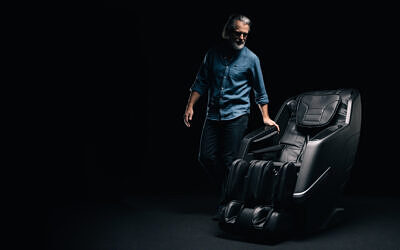
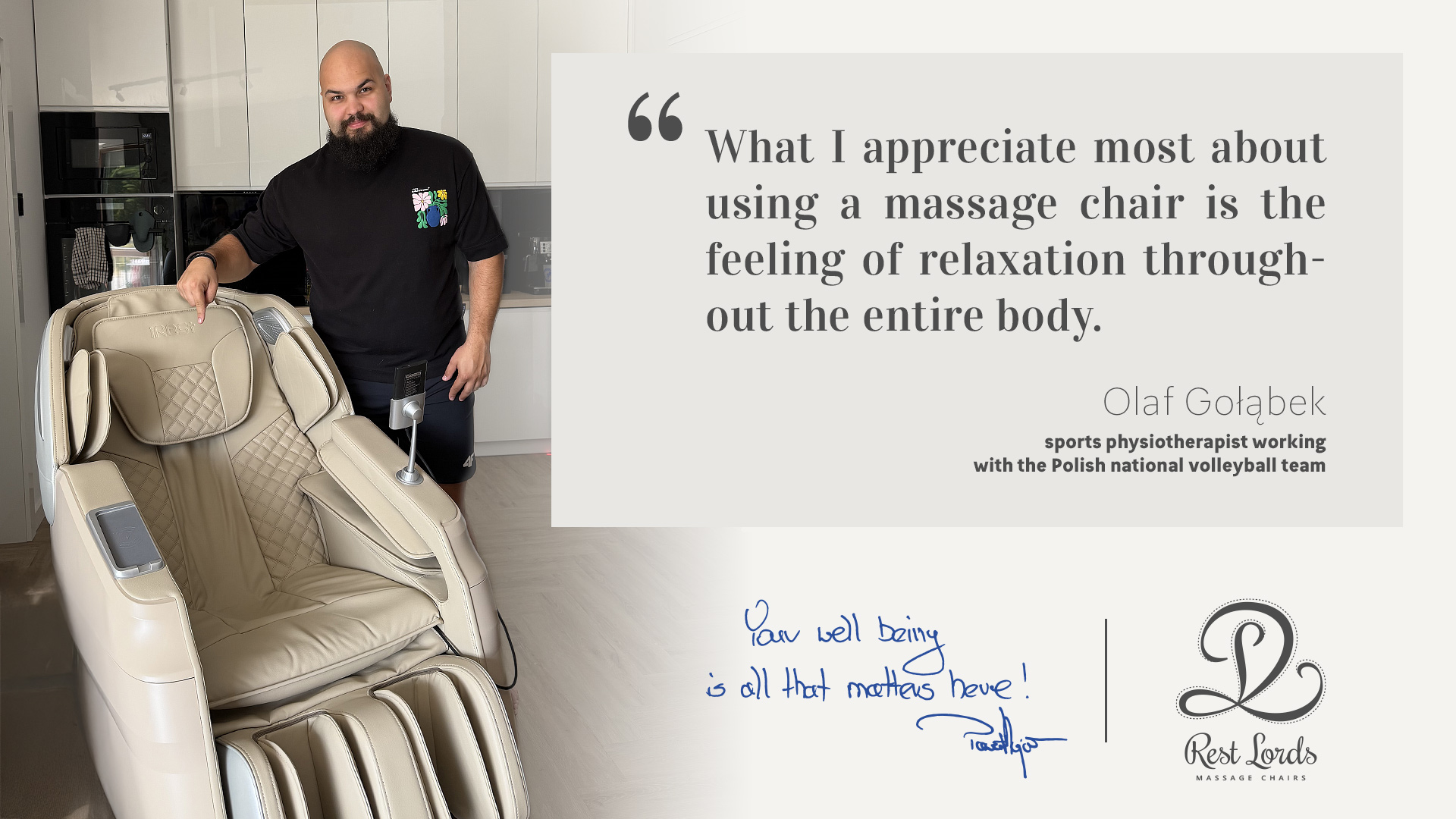
Tight muscles, discomfort, and back pain after long hours at a desk or behind the wheel, after a full day on your feet, and after an intense workout are now part of everyday life for many people. That is why we are paying more attention to recovery and conscious rest, which help reduce tension and better cope with everyday strain. Olaf Gołąbek, MSc, sports physiotherapist for the Polish men’s national volleyball team, knows this well and shared with us his experience of using the iRest Supearl+ massage chair.
What does a physiotherapist value most in a massage chair? The ability to relax the whole body, use massage regularly, and access it exactly when it is needed – after training, after work or in the evening, when it is time to rest and unwind.
Olaf Gołąbek’s perspective shows how regular massage can become a natural part of recovery, particularly when you are looking for a solution that is available without leaving home. As a specialist who works with athletes, he focuses primarily on the practical aspects of using a massage chair and the possibilities it offers for relaxing tense and overworked muscles.
Recovery as part of a healthy lifestyle
“Working as a sports physiotherapist, I see how important recovery is. Training is only one part of the puzzle, just as important as sleep, rest and properly relaxing overworked tissues,” Olaf Gołąbek begins his opinion.
A massage chair can be one way to introduce regular recovery into your daily routine. It requires no additional preparation or searching for a free hour in your calendar. Just a dozen or so minutes is enough to sit down, relax and allow yourself a moment of respite.
As the physiotherapist admits: “It feels great to sit down after a tiring day at work, relax and simply ‘switch off’ for a while.”
The potential benefits of using massage chairs are also indicated by a scientific review by Bo-Young Youn and co-authors, published in the journal “Explore”. The researchers analysed 18 studies, whose results indicate, among other things, reduced stress and mental fatigue, decreased muscle stiffness and lower perceived pain.1
After training, after work or whenever you need to rest
From a physiotherapist’s perspective, Olaf Gołąbek pays particular attention to the neck, back, especially the lumbar region, and legs. “This is where tension most often builds up after training, many hours of sitting or simply an intense day. Being able to use massage without leaving home is a huge advantage,” he says.
Research on post-exercise recovery also indicates that massage may help reduce muscle soreness 2 3 and improve flexibility 4.
Depending on the model, a massage chair covers different areas of the body. The massage arms may work from the neck, through the back, down to the buttocks or thighs, while airbags compress areas including the upper arms, forearms, calves and feet. Selected models also feature mechanical calf massage and roller foot massage. The massage range and solutions used always depend on the specific chair.
For Gołąbek, however, the most important thing remains the sensation after the session: “What I appreciate most about using a massage chair is the feeling of relaxation throughout the entire body.” This is why he believes that a massage chair can also work well as part of recovery for active people: “It works very well as a tool to use between training sessions or after a hard day at work.”
A dozen or so minutes whenever you have the time
One major advantage of a massage chair is its accessibility. There is no need to make an appointment or plan a journey. Massage is always within reach in your own home.
For the physiotherapist, what matters is the ability to use massage regularly whenever there is a moment for it during the day. “We do not always have the time or opportunity to visit a therapist. In such cases, spending a dozen or so minutes in a massage chair can be an excellent help,” he says.
A massage chair can easily become part of your daily routine without requiring you to reorganise your plans. Usually 15–20 minutes is enough to relax and release tension.
A good way to end the day calmly
Gołąbek also points to using the chair in the evening. A calm automatic programme can be a pleasant way to wind down after the day and prepare for rest.
“[…] the sleep-aid mode is an ideal way to end the day and helps you fall asleep faster, which supports recovery,” he emphasises.
Used this way, a massage chair can become a place you return to whenever you want to slow down and find a moment just for yourself.
A massage chair instead of a physiotherapist?
Here, the physiotherapist draws a very clear line: “Of course, a massage chair cannot be treated as a substitute for professional physiotherapy. In the case of an injury, trauma or pain, nothing can replace an individual assessment, diagnosis and therapy.”
A massage chair does not diagnose injuries and does not replace physiotherapeutic massage performed by a specialist. This is also confirmed by a study comparing the use of a massage chair with physiotherapy in people with lower back pain. Improvements were recorded in both groups, but physiotherapy produced better results in terms of pain reduction and improved physical function.4 The study authors emphasised that a massage chair should not be regarded as a substitute for physiotherapy.
Its role is different. A massage chair can complement everyday rest and recovery, helping you relax and take care of your well-being whenever you need it. If, however, an injury, trauma or concerning pain occurs, consulting a specialist remains the appropriate course of action.
Massage chair – a physiotherapist’s assessment
Physiotherapists’ opinions on massage chairs make it possible to look at their capabilities without exaggerated promises and assess them from a practical, professional perspective. Olaf Gołąbek summarises his opinion very simply: “If you want to rest, relax your muscles and create a small relaxation zone at home, a chair like this can be a really good solution.”
This is exactly the role in which a massage chair works best. Not as a substitute for physiotherapy, but as an easily accessible way to enjoy regular relaxation and recovery, whether after training, after a demanding day or in the evening.
Recovery does not always require an elaborate plan. Sometimes all you need is a dozen or so minutes, a comfortable massage chair and a moment set aside just for yourself.
The comments for this article were provided by Olaf Gołąbek, sports physiotherapist working for the Polish men’s national volleyball team, holder of a Master’s degree in physiotherapy and graduate of Andrzej Frycz Modrzewski Krakow University. We would like to thank him for sharing his experience and observations.


Scientific sources
- Youn B.Y., Cho H., Joo S. et al., Utilisation of massage chairs for promoting overall health and wellness: A rapid scoping review, Explore, 2024; 20(3): 285–297. DOI: 10.1016/j.explore.2023.10.002. ↩︎
- Davis H.L., Alabed S., Chico T.J.A., Effect of sports massage on performance and recovery: a systematic review and meta-analysis, BMJ Open Sport & Exercise Medicine, 2020; 6:e000614. DOI: 10.1136/bmjsem-2019-000614. ↩︎
- Wiecha S., Cieśliński I., Wiśniowski P. et al., Physical Therapies for Delayed-Onset Muscle Soreness: An Umbrella and Mapping Systematic Review with Meta-meta-analysis, Sports Medicine, 2025; 55:1183–1212. DOI: 10.1007/s40279-025-02187-5. ↩︎
- Kim S.K., Min A., Jeon C. et al., Clinical outcomes and cost-effectiveness of massage chair therapy versus basic physiotherapy in lower back pain patients: A randomised controlled trial, Medicine, 2020; 99(12):e19514. DOI: 10.1097/MD.0000000000019514. ↩︎